A Love Letter to Kinetica for PS2
Image: © Sony Computer Entertainment – Kinetica (2001) PlayStation 2 cover art. Developed by Santa Monica Studio.
The First Game to come from Sony’s Santa Monica Studio
There’s a special tier of early-2000s PlayStation 2 games that feel like they belong to another universe: dreamlike, experimental, and powered by the optimism of developers who suddenly had a lot of tech to play with. Kinetica is one of those games.
Originally released in October 2001 as Santa Monica Studio’s first-ever game, Kinetica was a high-velocity sci-fi racer built to debut their Kinetica game engine. The same technology later powered games like God of War, Ratchet & Clank, Jak and Daxter, Sly Cooper, and more.
Set across Earth’s futuristic cities, deep-space circuits, and far-off landscapes, Kinetica centered on nine racers wearing “Kinetic Suits,” cybernetic exoskeletons with wheels on the hands and feet. These suits let them scale walls, cling to ceilings, and blast past terminal velocity on 12+ tracks. Strange, stylish, and bold, the game carved out a cult legacy that still ripples through gaming history.
More than two decades later, Kinetica still feels like sensory magic. Here are six things about this surreal, high-speed oddity that continue to live in our heads rent-free.

1. The “Machine-As-Body” Aesthetic: The Biomechanical Racing Gear That Defined the Game
Kinetica’s most striking contribution to gaming imagery is its iconic biomechanical “Kinetic Suits,” which were half-motorcycle, half-cybernetic armor. Instead of riding vehicles, the racers are the vehicles, sleek exoskeletons transforming their bodies into fast, neon-lit blurs.
It wasn’t just stylish. It was smart sci-fi worldbuilding through character silhouette alone. Those flashy exoskeletons define the game’s visual identity. With wheels bolted to the hands and feet, articulated gauntlets built for climbing 90-degree surfaces at 350 mph, reinforced steel and chrome plate armor, and glowing vents that make the suits feel almost alive, the suits blur the line between fashion, technology, and anatomy.
Stylish and exploitative, the designs gave the game a mature, “cyberpunk couture” vibe, highlighting both athleticism and exotic sensuality. Even without much lore, the suits hinted at a larger world of futuristic sport, leaving players imagining the culture that could have created such wild, wearable machines. Even today, nothing else looks quite like it.

2. Kinetica’s Iconic Racers: Style, Personality, and Sexy Sci-Fi Cool
While the suits give Kinetica its signature aesthetic, the people inside them supply the attitude. Winning the season gives you a chance to see the human (or transhuman) underneath the gear. Every racer feels ripped from a turn-of-the-millennium club flyer, dripping with Y2K futurism: angular hairstyles, saturated color palettes, cybernetic implants, prosthetic limbs, and that distinctive “fashionable cyberpunk” edge.
And yes, the game clearly knew what it was doing with the camera angles for its female racers. The designers worked overtime making sure those butts carried as much screen presence as their speed. The cast is memorable not because the game fleshes out their backstories, but because each one is essentially a walking piece of concept art. They radiate vibe. They exist to look cool at high speed and they nail it.
It’s a vision of sci-fi swagger we don’t really see anymore: sleek, sensual, and a little mysterious. Pure distilled 2001, in the best possible way.
3. Bodies in Motion: Athleticism as Visual Storytelling
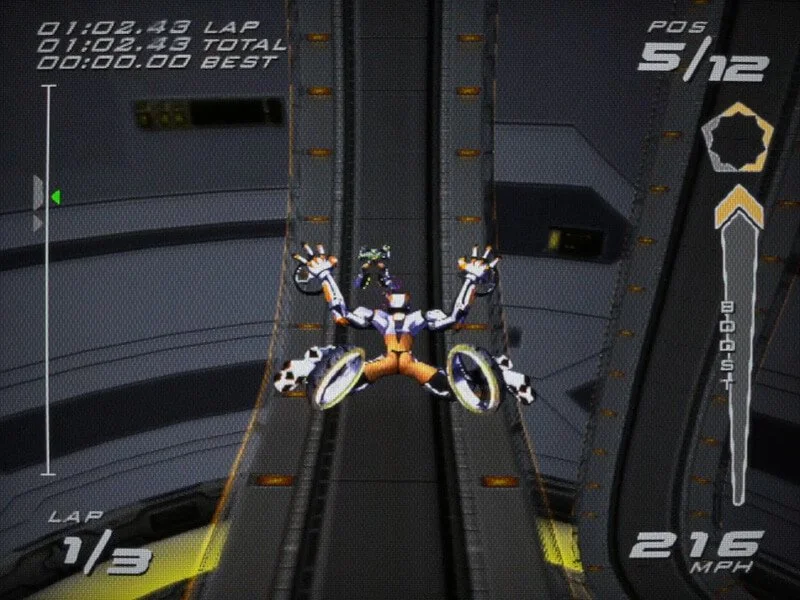
The game’s beauty isn’t limited to the character design, it’s in the movement. No other racer has replicated the strange, wonderful physicality of Kinetica. The racers are able to freely move their arms and legs, you can perform a variety of colorful aerial and ground-based stunts to refill your boost meter. Players are encouraged to twist, contort, spin, and somersault in midair, turning every jump into a chance to rewrite gravity. This tactile movement gave the game a visceral, sensory identity that made the whole thing feel a bit like parkour performed with a jet engine.
Instead of missiles or bumpers, Kinetica’s combat relies on fists and raw mass. If your racer is heavy enough, you can literally punch and body-check your rivals off the track at top speeds. The AI is tough, too, opponents will not hesitate to box your racer in tight spots and crash you when they can. They'll perform their own stunts to gain boost and use Power-ups to gain advantage. Like humans, they even mess up and fall off edges, too.
The result is a racing game that feels unusually alive: fluid, expressive, and guided by the motion of the human body. Everything has rhythm, almost like choreography. The racing is fast and risky, and the stunts land with a satisfying sense of impact.
4. Environments That Still Dazzle: A Pure Sci-Fi Spectacle
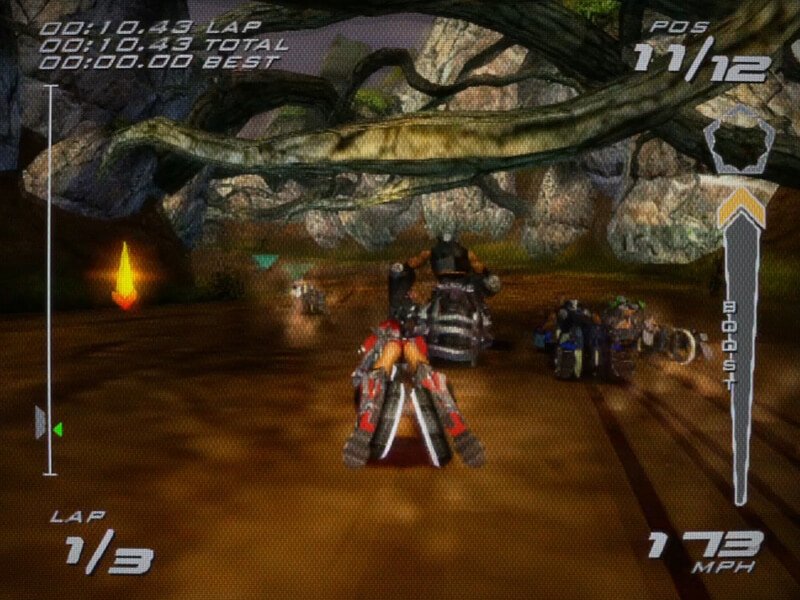
If there’s one thing Kinetica did better than almost any PS2 racer, it was building tracks that felt like self-contained worlds. Impossible cities, orbiting highways, technology-infused jungles, and industrial megastructures lean straight into dream logic. Its courses are wild architectural playgrounds and utterly unconcerned with realism. full of loops, vertical climbs, inverted tunnels, corkscrews, shortcuts, and plunging drops that push the racers and their kinetic suits to their physical limits.
The style feels like a mash-up of Blade Runner’s rain-soaked neon haze and The Fifth Element’s chaotic skyline, all filtered through a late-’90s club-scene glow of bright hues, liquid light trails, and rave-style directional lighting. Racing through these environments is a visual rush, with neon calligraphy sliding past, sparks from hand-drags bursting like fireworks, chromatic smears at top, and a white-hot bloom at peak Boost. Even today, Kinetica feels like a fever-dream roller coaster through a sci-fi megacity, overwhelming in the best, most exhilarating way.
5. Kinetica’s Trance-Fueled Audio Design
Few PS2 racers tapped into the early-2000s club soundscape as effortlessly as Kinetica. Its audio design is one of its most underrated strengths. The soundtrack mixes trance pulses, techno beats, and ambient grooves. The music doesn’t sit on top of the action so much as pulse within it, giving each level depth and rhythm, making them feel alive as if the music were echoing through the world itself. It perfectly captures that era when electronic music felt synonymous with the future.
What really stands out, though, is how smoothly the sound effects blend with the gameplay: the high-RPM whine of the suit’s internal machinery, the hum of accelerators, the sharp shriek of a boost, the thrum of massive engines as you pass, even the small grunts and hits during collisions. None of it feels loud or forced; everything feels like part of the world’s natural sonic fabric. The effects are crisp and purposeful to provide audio cues when needed. Running on and off a boost strip gives you appropriate cues to let you know if you're off the mark while other cues let you know when you're out of boost.
Together, the music and effects create a kinetic soundscape that gives the racing its rhythm. Every drift, boost, and fall becomes part of a larger electronic groove that makes your pulse spike. When you’re drifting along a glowing track or freefalling between platforms, those rhythmic synths and sound effects don’t just support the atmosphere, they create it, acting like the final color in the game’s neon palette.

6. A Sci-Fi Sport With a Dark Side: Kinetica’s Secret Dystopian Lore
One of Kinetica’s most intriguing qualities is the way it presents its world: suggestive, mysterious, and explained almost entirely through implication rather than exposition. The game offers only fragments of lore, yet every detail hints at something larger, like huge neon advertisements that imply a heavily commercialized future, characters with past lives we’ll never uncover, and complex, gritty urban or orbital tracks that suggest a society treating athletes as both spectacle and experiment.
Together these elements create a kind of negative-space narrative, where the lack of clear details makes the world feel larger and more mythic. That ambiguity also allows darker interpretations seep in: a dystopian sport performed for an unseen audience, racers trapped in biomechanical armor, a future where physics, safety, and even humanity are secondary to entertainment.
The result is a dreamlike world that seems to float beyond your reach, as if the sport would continue whether you understood it or not. It’s a soft form of storytelling that expands the universe quietly in your imagination.
In an era when racing games rarely bothered with worldbuilding, Kinetica whispered just enough to make you wonder, inviting players to fill in the blanks until the world feels too strange and too vast to fit on a PS2 disc.
Looking back, Kinetica feels like lightning in a bottle. A wild, stylish experiment that hit the gas and never looked back. An early step for a studio that would soon redefine action games. Few racing games before or since have blended movement, music, worldbuilding, and attitude with this much confidence. More than two decades later, we’re still thinking about it and still talking about it.